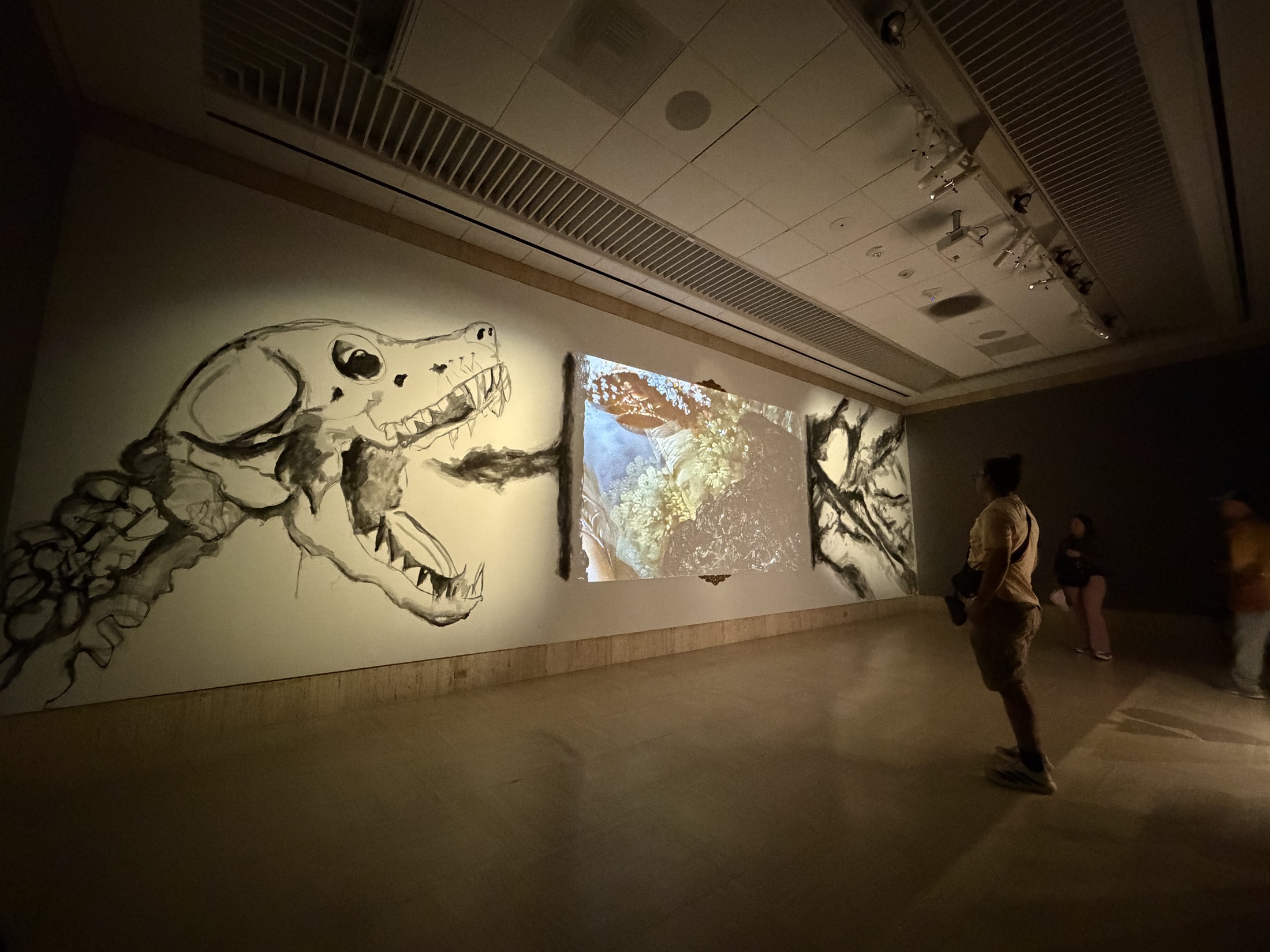
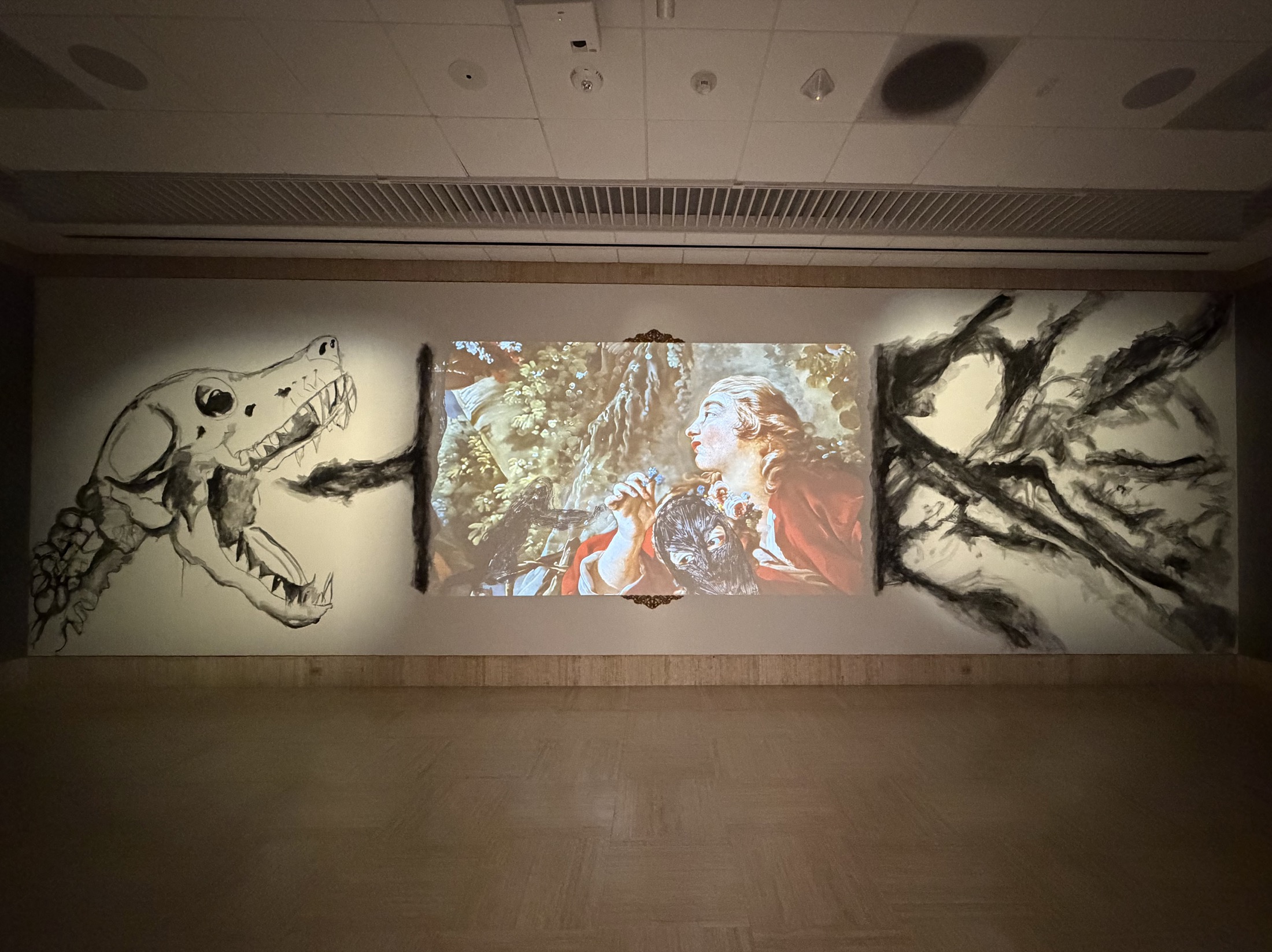
Installation view of Margaret Noble's Drift at the Timken Museum of Art. Photo: Sisif J. Patrick.
A Tantrum in Charcoal
Margaret Noble: Drift, Timken Museum of Art, San Diego, through September 6
At the Timken, Margaret Noble draws a skeleton, crows, and shadows over a Boucher pastoral. She hasn't exposed a fantasy. She's replaced it with a flimsier one.
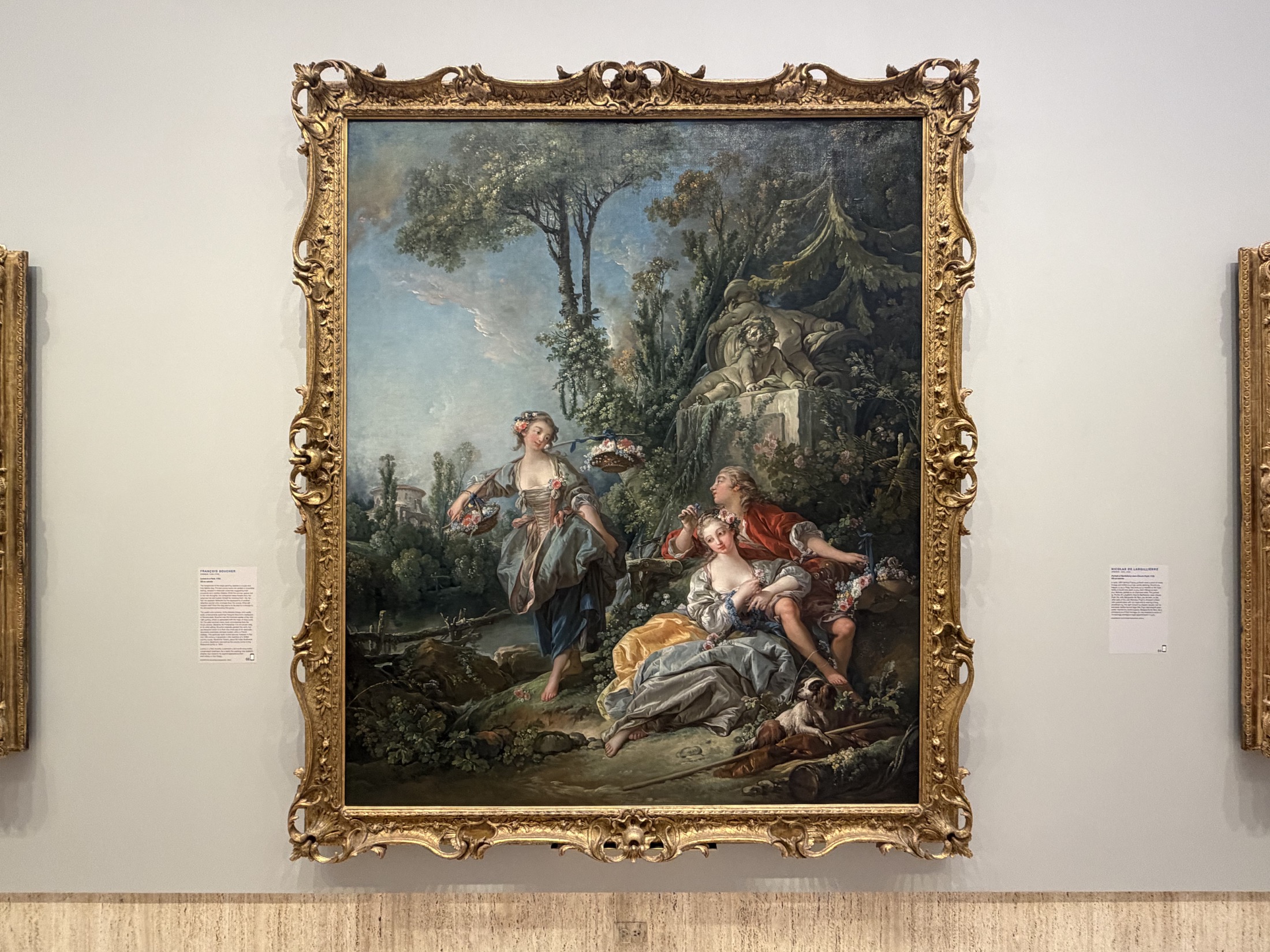
SAN DIEGO, CA - The best idea in Margaret Noble's Drift is the title. François Boucher's Lovers in a Park, painted in 1758 for a decorative scheme in France, drifted to a Rothschild house in England and then to Balboa Park, where the Timken bought it in 1965 and has rarely let it leave since. Noble's five-minute video drifts too, a slow camera wandering the picture's surface. Nice. Then you look at the rest of the wall.
To the left of the projection, an animal skull the size of a car, somewhere between wolf and crocodile, jaws open, spine and ribs trailing toward the floor, painted in black ink that reads as charcoal from across the room. A black ribbon runs from its mouth to the edge of the projected image, so it appears to be spitting on the Boucher. To the right, a thicket of dead branches reaches in. Between them, framed top and bottom by two small gilt ornaments, is the only color in the room: an AI-restored copy of the painting, faces buffed smoother than Boucher's brush left them, the camera zooming into powdered hair and a red coat while painted black silhouettes creep across it. Hunched shades, a cat, crows, bodies dropping out of the sky. Sliding drones on the soundtrack.
The premise is that this is truth confronting fantasy. It isn't. It's fantasy confronting fantasy, and the newer one loses. Boucher's is disciplined: one composition, every fold and gesture decided, a whole social world of self-aware artifice behind it. It holds still, and it rewards looking. Noble's is a starter kit of the gothic — skull, crows, a black cat, shadow people — dark but oddly lightweight, more Halloween than memento mori, and it never holds still. The camera drifts because nothing here has been composed. The muddying isn't an argument, it's a mood.
The argument, such as it is, is also very old. Diderot, reviewing the Salon of 1761, said Boucher had everything except truth. The skull arrives two and a half centuries late to a fight the painting lost in public and survived anyway. Twilight of the ancien régime is hindsight. In 1758 the Revolution was thirty years off, and nobody in the picture knows they're doomed. Only we know, and the installation invites us to enjoy knowing.
The wall text splits the viewer in two: the child who sees pure fantasy, the adult who knows what fantasy costs. In the room the roles are reversed. Boucher is the adult, composed and finished. The intervention is the child, and not the wide-eyed one the text imagines. This one found the charcoal and is having a tantrum on somebody else's painting.
The skull is a good drawing. I'll give it that. Then walk the thirty steps to the real thing, still free to see, still holding still. It has survived Diderot and two centuries of shipping. It will survive the crows.