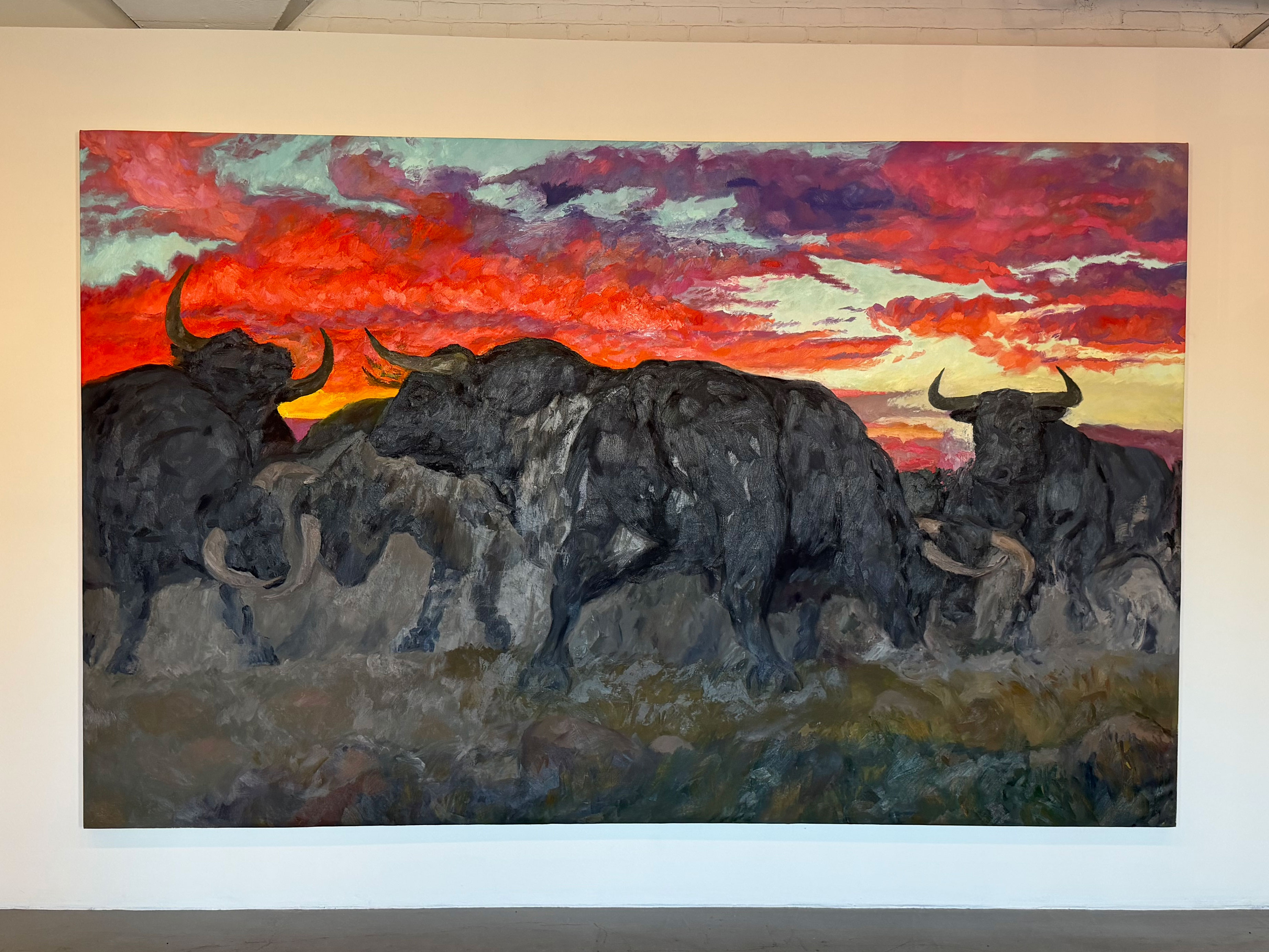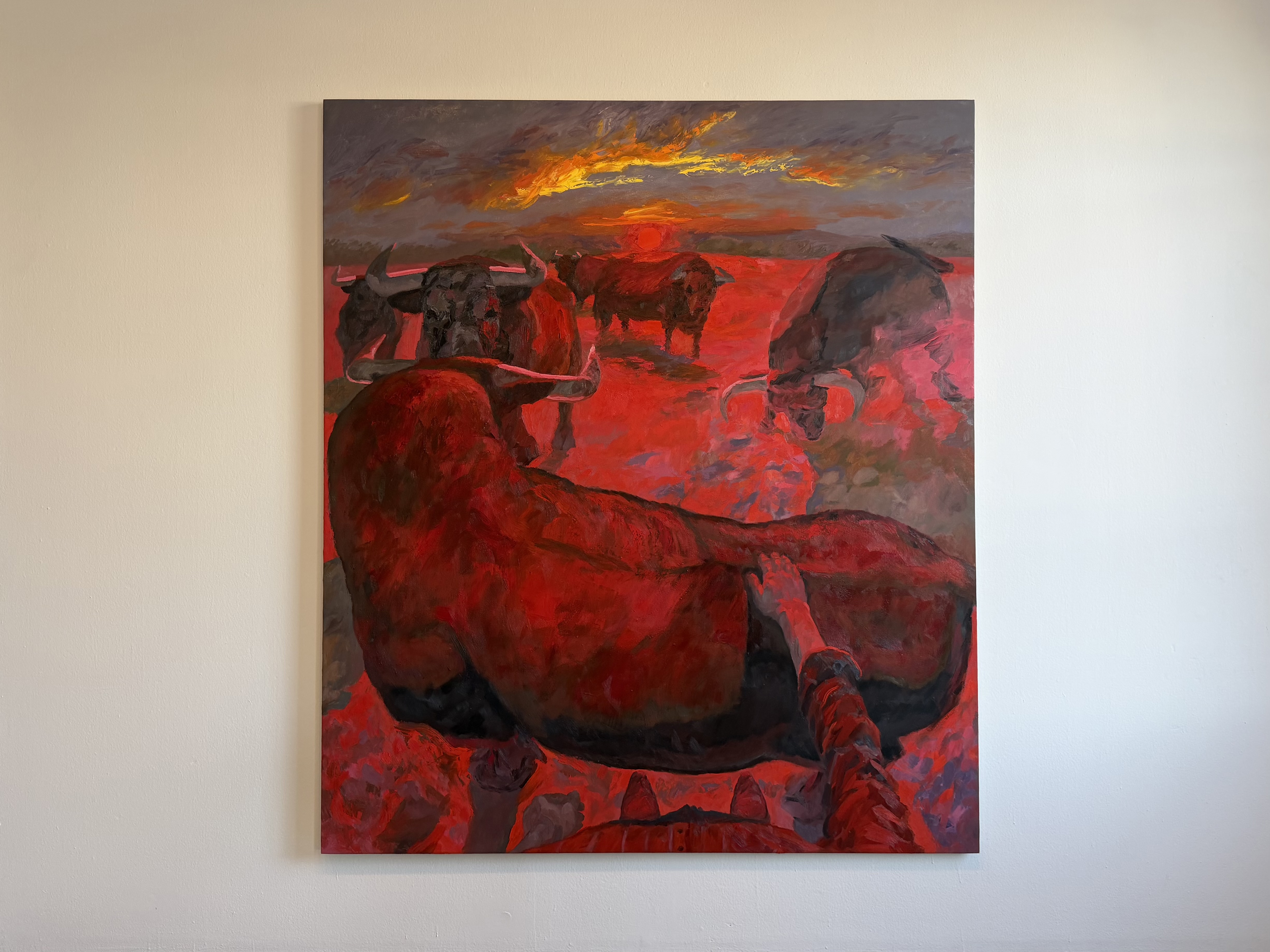
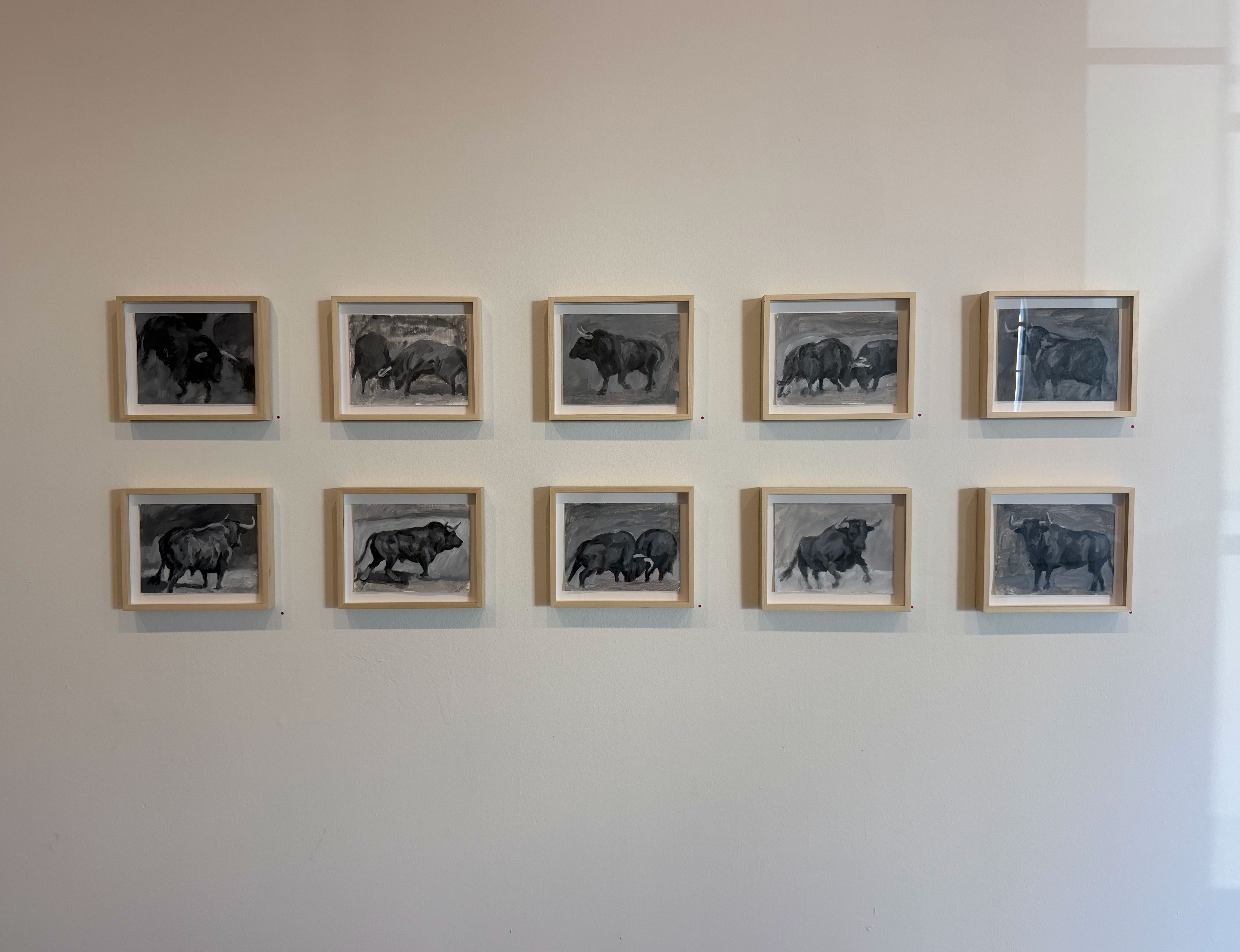
Installation view of Bryan Ali Sanchez's Raíces en el Campo at Bread & Salt. Photo: Sisif J. Patrick.
Bulls, Again
Bryan Ali Sanchez: Raíces en el Campo, Bread & Salt, San Diego, through November 21
Back from Yale with confident brushes and the oldest subject in painting, Bryan Ali Sanchez fills Bread & Salt's main gallery with skill, scale, and a first person holding a camera.
SAN DIEGO, CA - Raíces en el Campo, in Bread & Salt's main gallery, is a homecoming staged at full volume: Bryan Ali Sanchez grew up in Logan Heights, the gallery's own neighborhood, went from City College to Cal State Long Beach to a Yale MFA, surfaced at Perrotin and in galleries from Beijing to Madrid, and has come back to the flagship space of his childhood streets with wall-sized canvases of bulls.
The skill is not in question. The strokes are confident, the color intelligence real — a herd massed like one dark muscle under a crimson-and-mint sunset; another herd in sour chartreuse and olive under a small red sun. The handling would please the colorists he cites, Bonnard and Doig. I walked the room impressed and unmoved in equal measure. Bulls. Why. Again. Painters have put bulls on walls for seventeen thousand years; they are the medium's first subject, before gods, before us. Goya serialized them, and Picasso annexed the animal as autobiography so completely that every painted bull since files a small claim with his estate. A bull entering a canvas in 2026 arrives pre-meant and pre-sold, and the wall text completes the transaction in writing: the struggle of ranch labor, it says, is "symbolized through the figure of the bull." When the press release does the symbolizing, the paintings are excused from it. Five years ago, in this same building, Sanchez showed migrants scaling the border wall at night — a subject with stakes. No artist owes the market his community's trauma on subscription, and retiring it has its own integrity. But the replacement has to generate its own necessity, and a bull at sunset is the subject that has never once frightened a collector. A grid of ten small grisaille studies, framed in blond wood, prices the point.
Twice I thought necessity had arrived. In the big red canvas — a landscape soaked the color of a wound — a human forearm, wrapped for work, enters from the bottom edge and reaches for the flank of a downed bull. In the chartreuse painting the bottom of the canvas is a horse's head and reins: you are mounted, the herd surging away between your animal's ears. First person, at last. A position, not a symbol. Then I recognized the position. An arm extending into the frame is how an action camera sees. The view between a horse's ears is the most-taken photograph on any trail ride in the world. These are first-person paintings, but the first person is holding a camera, and what the camera is doing is what the wall text says the artist did: visiting. The reach is the visitor's gesture — work doesn't reach toward cattle, it ropes them, brands them, drags them. Did he ride, did he herd? The question sounds like biography-policing, and I'd drop it if the paintings didn't keep answering it themselves: their grammar is the tourist's grammar, proximity documented, contact almost made. Neither Logan Heights nor New Haven runs cattle. Querétaro does — on the days the family visits. And the visit is not my inference. In a 2019 interview Sanchez described his childhood Mexico plainly: trips with his mother that met, again and again, a relative's death — a grandmother seen at seven and gone within days, funerals threaded through his youth. His Mexico has always been the place one arrives at from elsewhere, and where arrival keeps meaning mourning.
Which is the show that got away. There is an honest exhibition hiding inside this one, and it is about exactly that distance — the first-generation son whose roots are in the field and whose hands are not, reaching across class and geography toward a life that is his in blood and not in labor. If some of this room's emptiness is mourning's emptiness, the show's mistake is not vacancy but mislabeling — grief dressed as labor, loss exhibited as heritage. But the show as framed claims the weight of the work, at the scale of importance, in the colors of blood, and the paint keeps confessing the visit. That gap no amount of skill fills, because the skill is what built it.
Sanchez once defined his project as confronting Mexican hyperbolic clichés. The bull is the largest cliché Mexico owns, and by his own measure the herds surrender to it; only the two canvases with a body in them put up the fight he promised. Raíces en el campo: roots in the field. Roots are what the departed have. The people still there call it work. Twice Sanchez painted the distance, arm outstretched, maybe without meaning to, and those are the canvases to trust. The rest is a herd, handsomely painted, headed where herds go: to market.