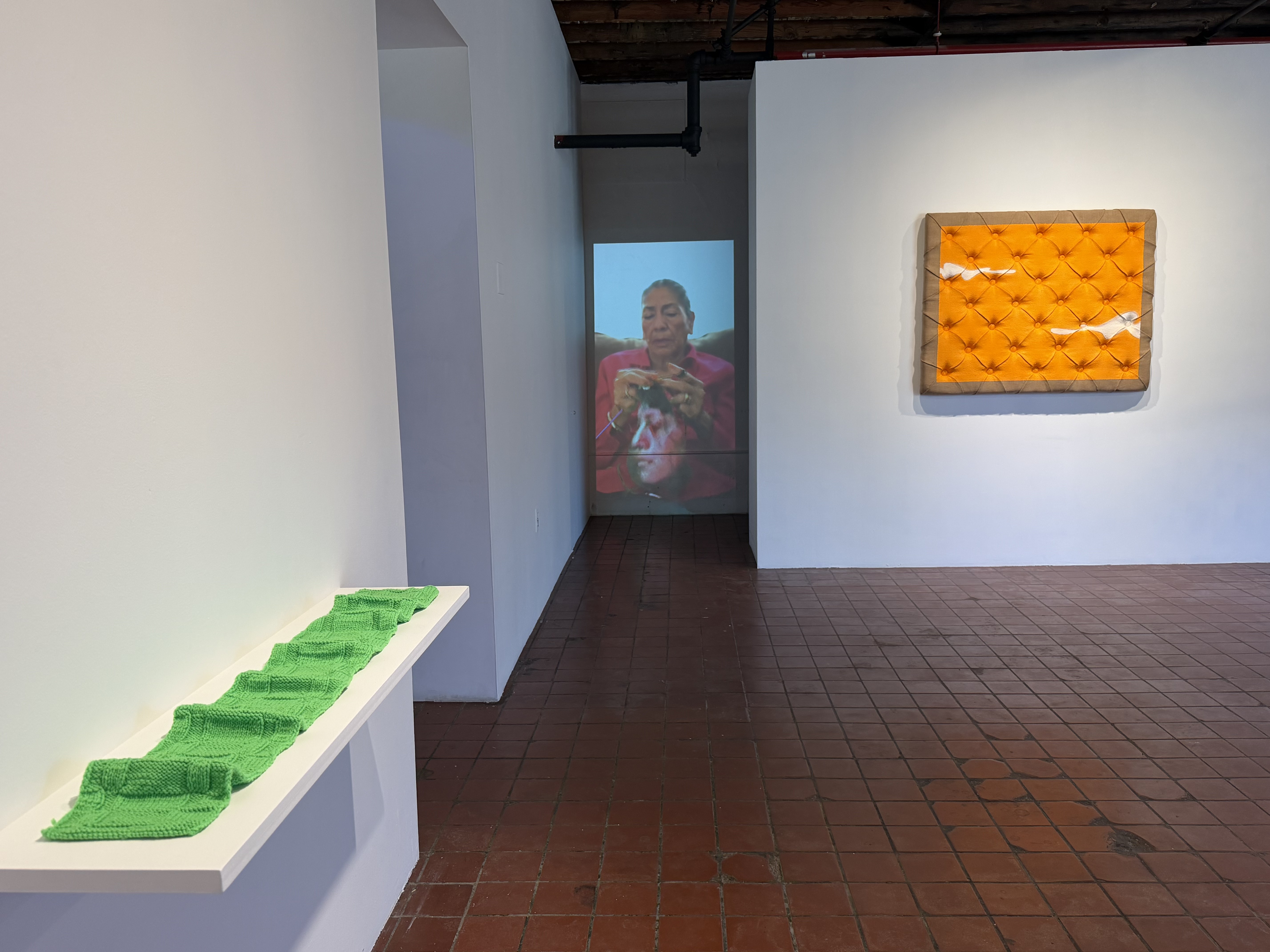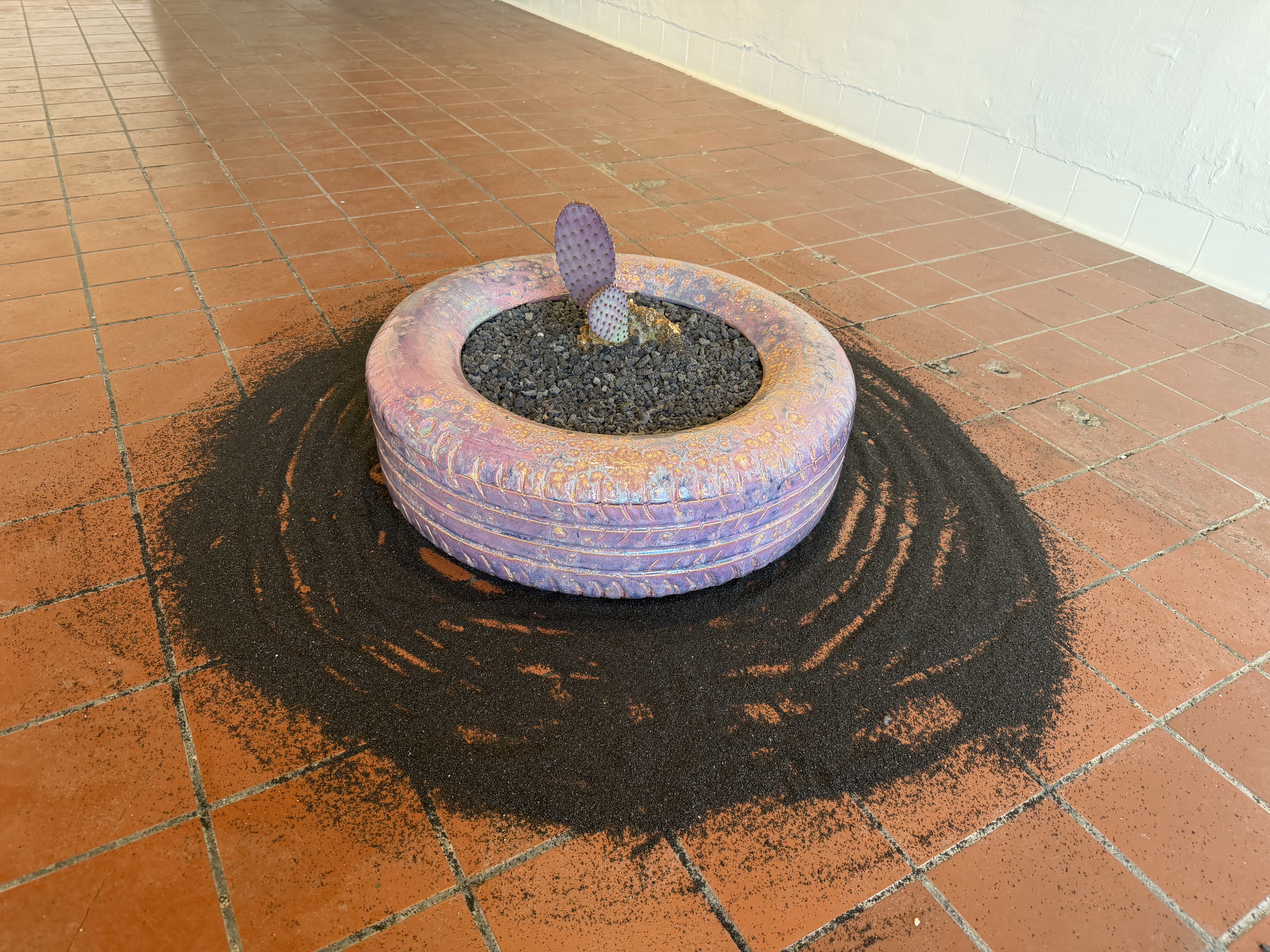
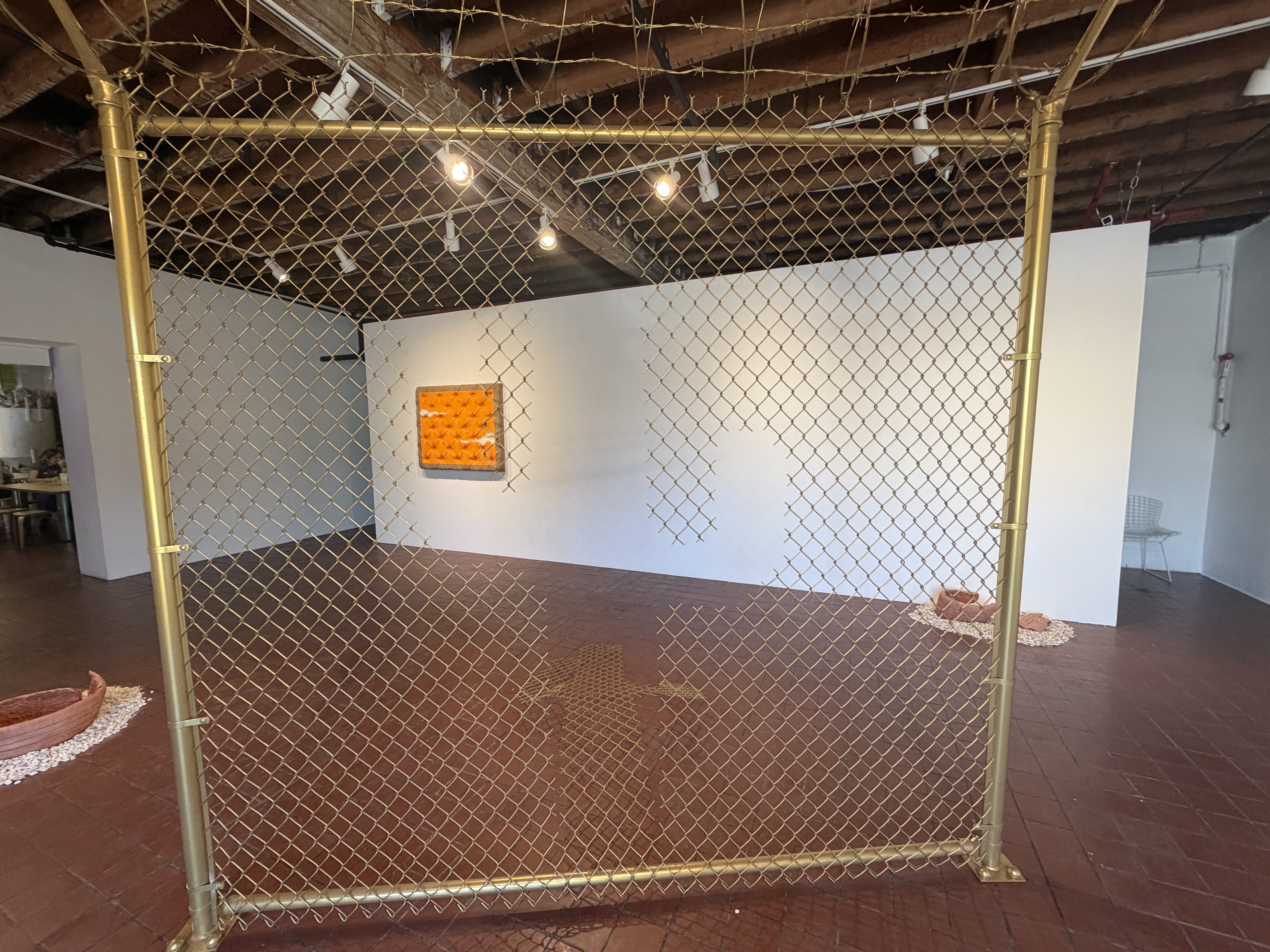
Installation view of noé olivas's Tierra y Cielo at BEST PRACTICE. Photo: Sisif J. Patrick.
Postcards From the Border
noé olivas: Tierra y Cielo, BEST PRACTICE, San Diego, through October 17
noé olivas gilds the fence, turns tires to clay, and un-knits a cactus-shaped hole in the golden cage. Every move is handsome. Every move is pre-owned.
SAN DIEGO, CA - For the second time this fall, the Bread & Salt building has put me to work. Downstairs from the Athenaeum, in the one-room nonprofit BEST PRACTICE, noé olivas has installed Tierra y Cielo: a chain-link gate gilded head to foot, razor wire and all; tires remade in ceramic; garden shears clamping glazed nopal pads to the wall like brooches; a video of an elder woman knitting; and a sunset upholstered in orange tuck-and-roll, buttoned like a lowrider's back seat.
I'll confess the seduction before the verdict. The gate's mesh has been un-woven at its center into a nopal-shaped void, the extracted links spread flat below like the plant's shadow, and if you stand at the breach the sightline runs straight through the cactus-hole to that upholstered sky. For a minute I had the rave written: the golden cage of the corrido, the one Los Tigres del Norte have sung since 1984, finally raveling; chain-link exposed as the state's knitting, undone with a family's patience. Then I noticed what I was doing. I was composing a sentence that would hand you the entire work, and you would lose nothing by staying home. The room even supplies the caption: look through the gate and a ceramic nopal, clamped in garden shears, hangs on the wall beyond the breach — the void and its explanation lined up in one view. A work that mails this well is a postcard.
And every card on this rack has been printed before. Artists have been operating on this fence longer than some of them have been alive: Richard Lou stood a free-standing door on the line itself in 1988 and hung it with keys for the Mexican side; Ana Teresa Fernández painted the fence the color of sky to erase it in 2011; Postcommodity floated balloons over it; JR stood a toddler behind it. The knitting metaphor is older still. Feminist fiber art established craft-against-power as a thesis in the 1980s; Consuelo Jimenez Underwood has woven actual barbed wire into her textiles for three decades; and Tanya Aguiñiga's AMBOS project spent two years collecting knots from commuters at the San Ysidro crossing, twenty minutes south of this room, then lashed weavers together through the fence itself in Arizona. Against that lineage, grandmother-loops-people, state-loops-steel is an equation that solves on contact. The remaining inventory is likewise stocked. Tires rebuilt in craft materials: Marilyn Levine was remaking leather jackets in ceramic by 1971, and Betsabeé Romero has carved tires since the 1990s, and gilded them too. Ceramic nopales: Margarita Cabrera sews hers from Border Patrol uniforms and plants them in terracotta pots, a sharper sentence than glaze can write. Even gilding the instrument has a pedigree: Sherrie Levine cast the urinal in polished bronze in 1991. And the sunset concedes the case. It is upholstery presented as painting — sofa art, for once literally — and it is the prettiest thing here.
None of this is lazy. The crystalline glaze on the lavender tires is genuinely difficult; the gilding is immaculate; un-weaving chain-link into a drawable shape is slow, careful labor, and the shadows the shears pieces throw are the best draftsmanship in the room. The craft is real. But craft spent restating the genre's greatest hits produces exactly what the show's own press release fears: comfort. Migration, memory, belonging, ancestors, the divine — every noun accounted for, every noun inherited, arranged beautifully, at the precise moment when the border is producing new facts daily and this room produces none. The tumult outside is doing the work the objects don't. A visitor moved here is moved the way one is moved by a well-chosen card: the sentiment is true, and someone else wrote it.
The show is scaled honestly to its small room, and olivas's résumé says he can do more than this — his community work builds things postcards only depict. But judged on what hangs at BEST PRACTICE through October 17: a golden cage assembled from forty years of other people's verses, a hole in the shape of the one image the genre was already tired of, and an elder's needles looping quietly on a loop. A show full of needles. Not one of them moves.