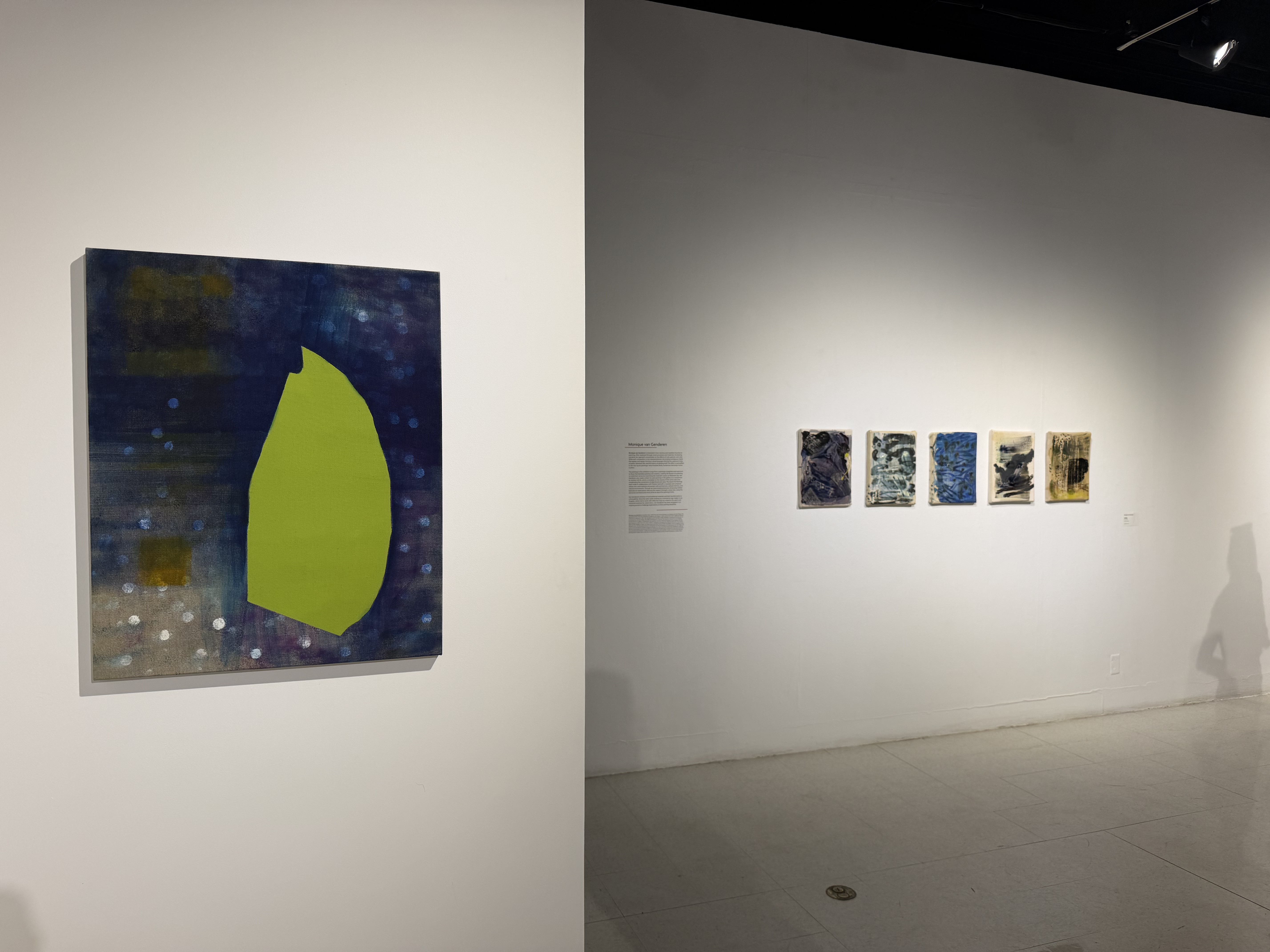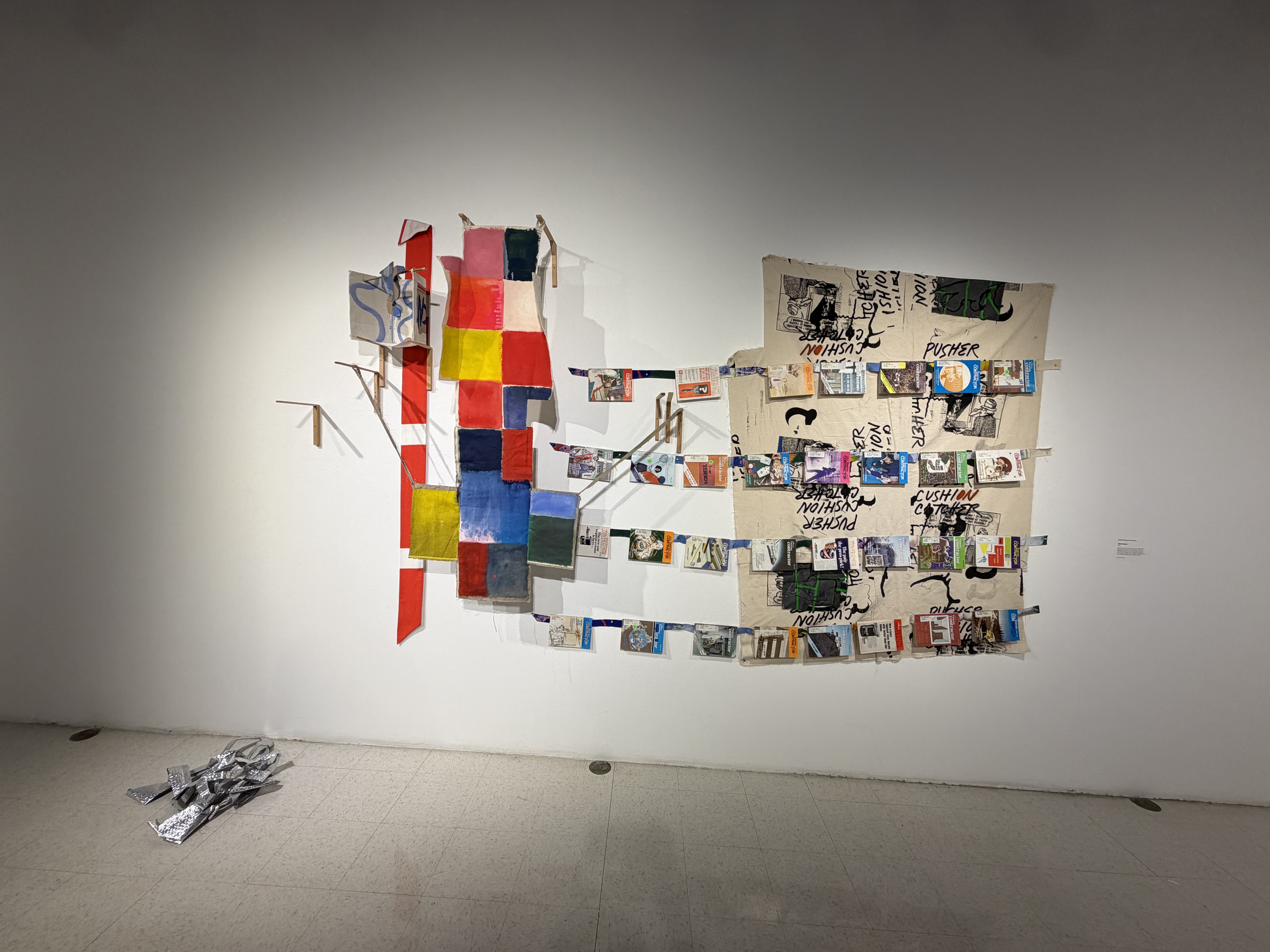
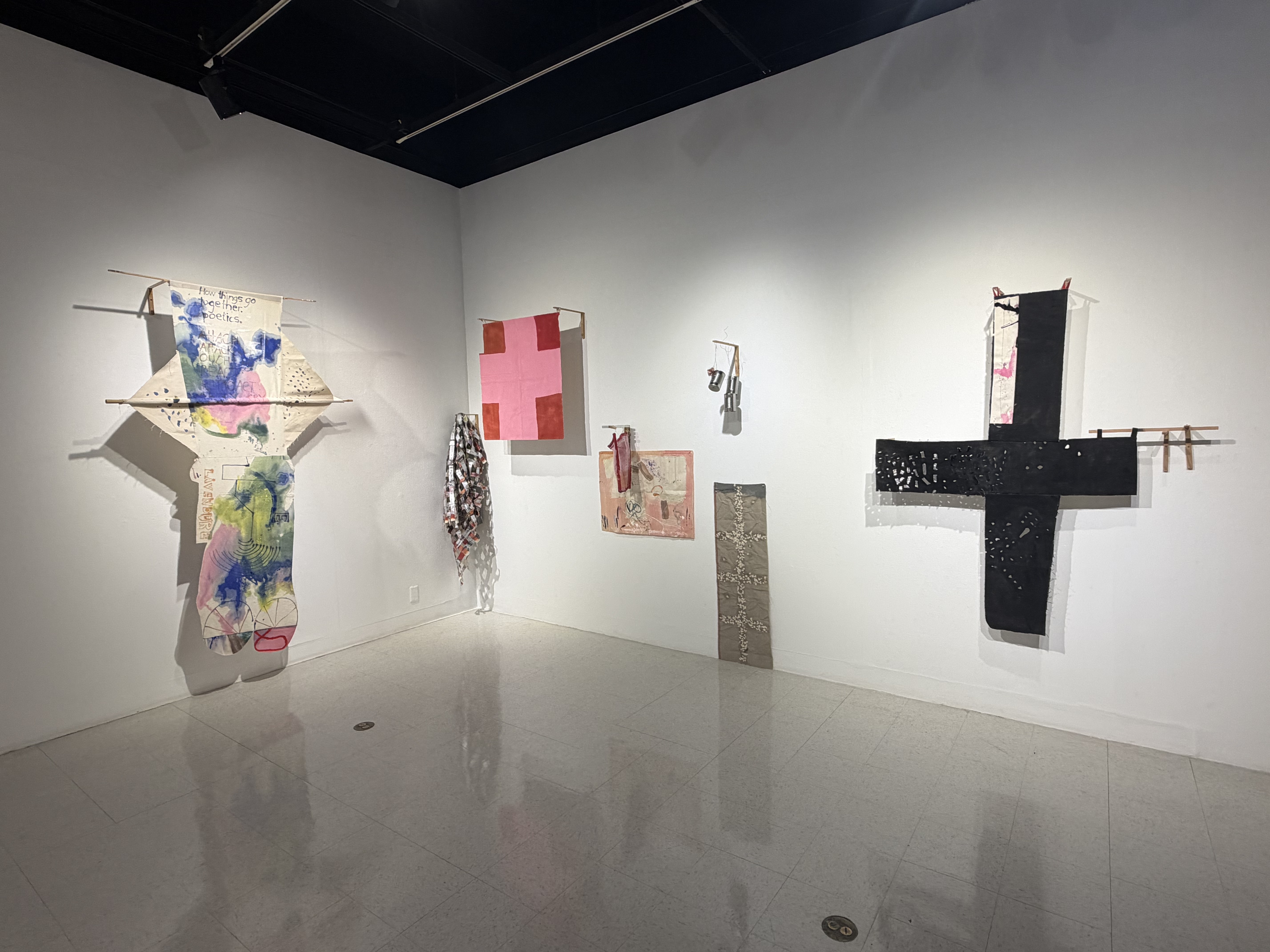
Installation view of Edgeless: In the Expanded Field of Painting at SDSU University Art Gallery. Photo: Sisif J. Patrick.
The Missing Diagram
Edgeless: In the Expanded Field of Painting, SDSU University Art Gallery, through December 3
Four painters cross painting's edges at SDSU's University Art Gallery. The exhibition around them never draws any.
Edgeless: In the Expanded Field of Painting has, on paper, everything a university gallery show should want. Four serious artists spanning thirty-one years of birthdates, two of them — Monique van Genderen and Molly Zuckerman-Hartung — mid-career figures with real arguments behind them. A premise with a pedigree, credited on the wall to Rosalind Krauss's 1979 essay. Free admission, students from the MFA show across the hall drifting through, curated by Jacqueline Marino. I went in prepared to like it, and I left having liked exactly half of it, which is not the problem. The problem is the room.
Walk it and try to find the beginning. There isn't one, or a middle, or an end. The four artists are interlaced along the walls on no logic I could reconstruct in the space — not chronology, not conversation, not contrast — and freestanding partitions stand in the gallery less like arguments than like shelving, walls waiting for inventory. More kept coming: the count of works grows as you circle, quantity doing the job of sequence. The whole thing hangs like laundry put out to dry. Which would be an unkind image except that it describes a mechanism. Zuckerman-Hartung's installation is deliberately clothesline-like — banners on dowels, fabric on jutting pine brackets, distance between work and wall as a stated method. Deliberate slack needs a taut room to read against. Hang the entire exhibition loose and her looseness dissolves into the ambient sag; the installation mutes its own strongest artist. And here the title turns on the show. Edgeless is a fine condition for a painting. It is a fatal one for an exhibition, whose whole art is edges — where one thing stops, what it stands next to, in what order. Krauss wrote her essay because a category had collapsed into mush, and her answer was a diagram. The show borrows her phrase and skips her lesson.
What survives the room does so by carrying its ideas on its body. Zuckerman-Hartung's Pusher Cushion is the exhibition's best fifteen minutes: a clothesline construction threading thirty-one issues of American Painting Contractor magazine, mid-seventies to early eighties, from the collection of one named tradesman in Farmington, Connecticut, his mailing labels still on the covers. In a show expanding painting by way of French theory, she expands it by way of the Yellow Pages — toward the other profession the word names, the one with ladders and bids — and you need no caption to get it, because the covers and the address labels are the argument. Her sewn nylon grids, The Safety Dance and Browntown, shown seam-side out with paint pooled in the channels, transmit too: wrongness you can see. Van Genderen's Fire Paintings, made with the San Diego composer Preston Swirnoff, are sheets of colored beeswax honeycomb fitted with cotton wicks and lit — the burns and the drips explain themselves, the grid arriving pre-made for bees and leaving scorched. But her wittiest work defeats itself in person: five modest canvases that are not canvas at all but kiln-fired clay, imprinted with weave, glazed to counterfeit painting. A perfect forgery is invisible until a label confesses it, and in the room they read as five small paintings, which is the joke and also the problem. The show's one staged conversation — her paintings said to bracket Pusher Cushion — I could not perceive standing in front of it. The dialogue exists in prose.
The other half doesn't survive. Anna Betbeze's Flokati rugs — acid-dyed, scorched, shredded — were a genuine shock fifteen years ago; the shock has fully amortized, and what remains must live on color and scale alone. Hers didn't hold me: stained rugs, exactly as advertised, the recipe quoted back without a dish. (A footnote for the seminar across the hall: her true Krauss is not the expanded field but the formless — matter dragged low — and a show citing one while hanging the other, unexamined, is a seam somebody should have noticed.) Lizzie Zelter, the emerging local, brings her real subject — she has painted the switch plates and wall hardware of daily life for years, and her Intercom piece hangs wittily by the entrance, a painting of a wall fixture mounted like one, buzzing you into the show. But the hand is fast where the idea is slow: silk on thick acrylic, twice a screen, brushed at the speed of a scroll. Notation, not attention. In a room where one colleague fired counterfeits and another archived a tradesman's decade, lightness reads as spending something genuine for too little.
I kept returning to a title. Pieces of You, Zuckerman-Hartung calls her room of flags — the pink cross, the black Malevich cross punched with holes and hung off towel racks. I went looking for the you. No body, no figure, no one; pieces of an absence the exhibition never introduces. That, finally, is the show: real parts, no person — materials in the expanded field with nobody to say why the field was worth entering. The two artists who know why brought their reasons along and mostly kept them legible. The exhibition offers its students the other lesson, the wrong one: that expansion means hanging things loosely and letting a citation do the connecting. Krauss expanded the field by drawing a diagram over it. Here the field is expanded, all right. The diagram is missing.