Installation view of Thao Huynh French's Future Flowers at Mesa College Art Gallery. Photo: Sisif J. Patrick.
Two Tapes
Thao Huynh French: Future Flowers, Mesa College Art Gallery, San Diego
Thao Huynh French's debut solo show holds a family archive that brought some at its opening to tears. Whether the art earned them is an older question than it looks.
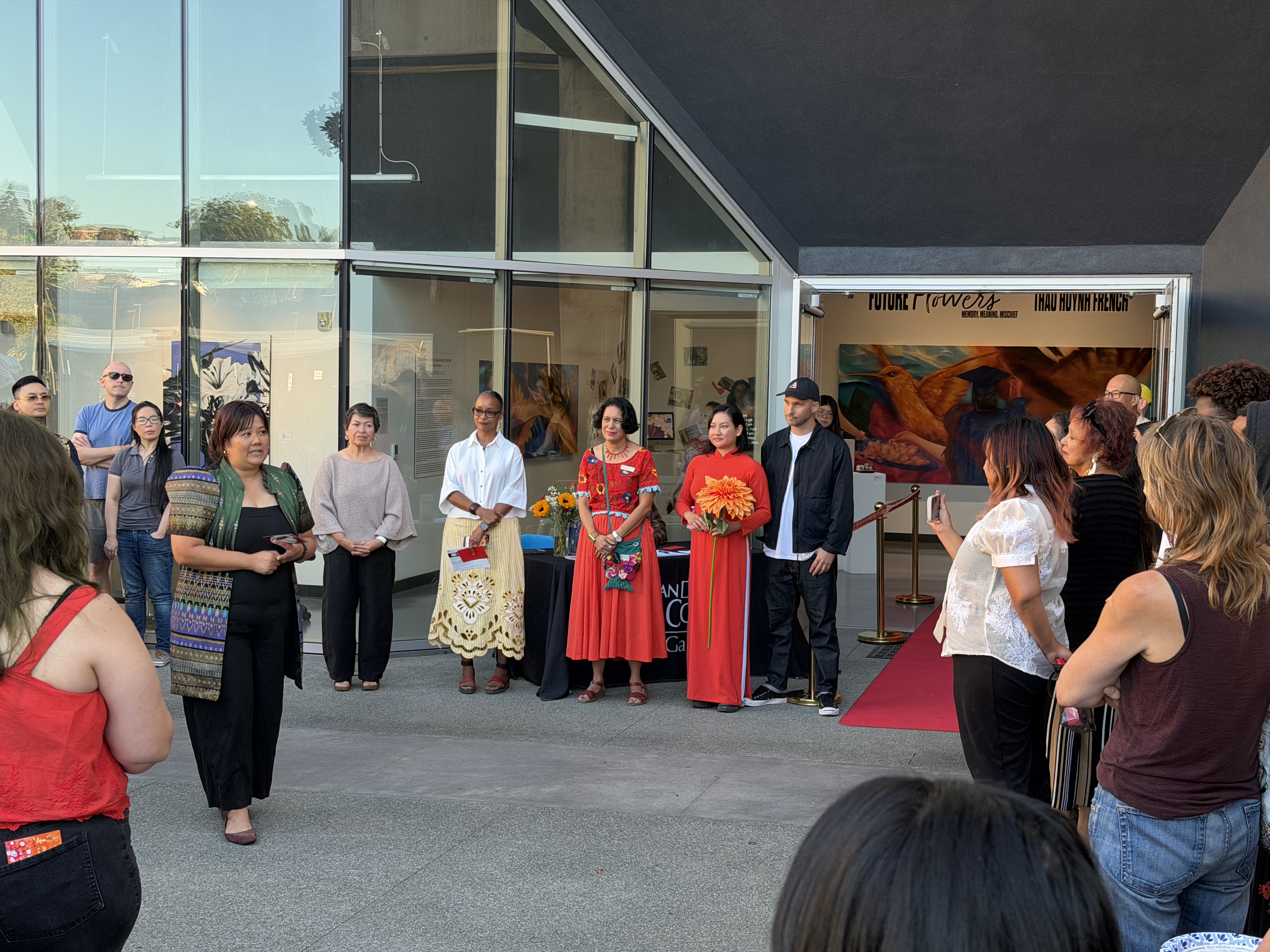
SAN DIEGO, CA - At the opening of Future Flowers at the Mesa College Art Gallery, there was a red carpet flanked by red tape printed with the show's title, strung on gold stanchions, steering everyone in. There was a lion dance, and the artist in a red áo dài holding one enormous dahlia. During the remarks, a few people around me teared up. The applause was long and meant. Nobody doubts the feeling in that room. What produced it, though — the history or the exhibition? Those are not the same thing.
The show is Thao Huynh French's first solo exhibition, which is its own strange fact. She has painted more than four hundred murals; the two newest, made with Mesa students for the campus counseling center, hang here before installation, all soaring birds and a graduate in cap and gown. Around them, everything at once: flower canvases, a portrait of Nika Shakarami, heirloom áo dài, a LEGO storefront wearing one of her murals, a lotus field glowing like a lightbox, family photographs, a rotary telephone, student collages, gold keys hung beneath handwritten affirmations. A debut this delayed behaves like a retrospective, everything sayable said at once, and the subtitle confesses it — Memory, Meaning, Mischief, three m's, alliteration doing the work of an argument. A gallery, though, is a different test than a wall. Murals must please committees and read at a glance. Galleries ask what's left after the glance.
Shows billed as social justice make me brace, because the genre has learned a trick: stand the cause behind the work, so that judging the work feels like doubting the cause. Nobody wants to be the one who reviewed refugees. But prejudice can't become a rule — say political art isn't art and Goya hands you The Third of May 1808, Picasso hands you Guernica, and half the canon files in behind them, since altarpieces served the church and portraits served the crown. The workable test is smaller and harder: can the message be detached? If the work survives being restated as a pamphlet with nothing lost, the form was packaging; Guernica cannot be restated, because the screaming horse is not a position paper.
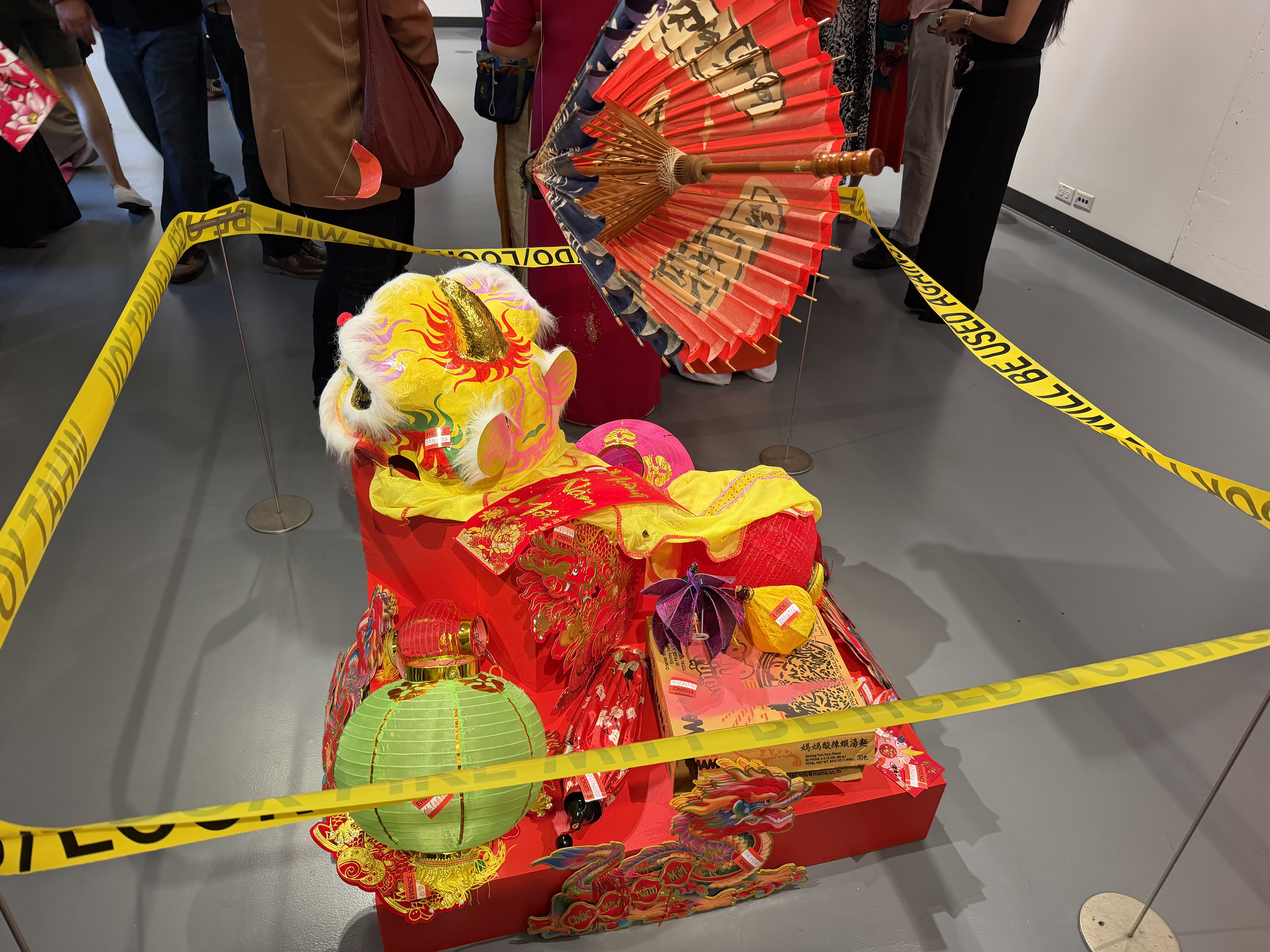
Now the centerpiece. A heap of Lunar New Year belongings, lion head, lanterns, a calligraphy parasol, a case of instant noodles, cordoned off by yellow police tape printed with the words WHAT YOU SAY, DO, LOOK LIKE WILL BE USED AGAINST YOU, red envelopes and the parasol suspended midair as if caught fleeing the raid. A festival impounded as evidence. On opening night the lion danced around the cordon, which made it better. Still, my first verdict was harsh: a work that prints its own caption has done the detaching for you, and after one glance it is spent, the muralist's thirty-foot instinct carried indoors. Then I thought again about the entrance. That red ribbon steering us in was also custom-printed tape, on gold stanchions I have never seen at this gallery, and the same mind made both. That changes the piece. The medium runs twice, once as welcome and once as suspicion, her title on one tape and the state's accusation on the other, and you walk the distance between them. A caption cannot do that. It is the closest thing to form in the show, and it arrived disguised as ceremony, which fits. The subtitle promises mischief, and mischief is this artist's true medium: she entered the camp posing as a field trip's photographer, and she entered her own opening posing as event staging.
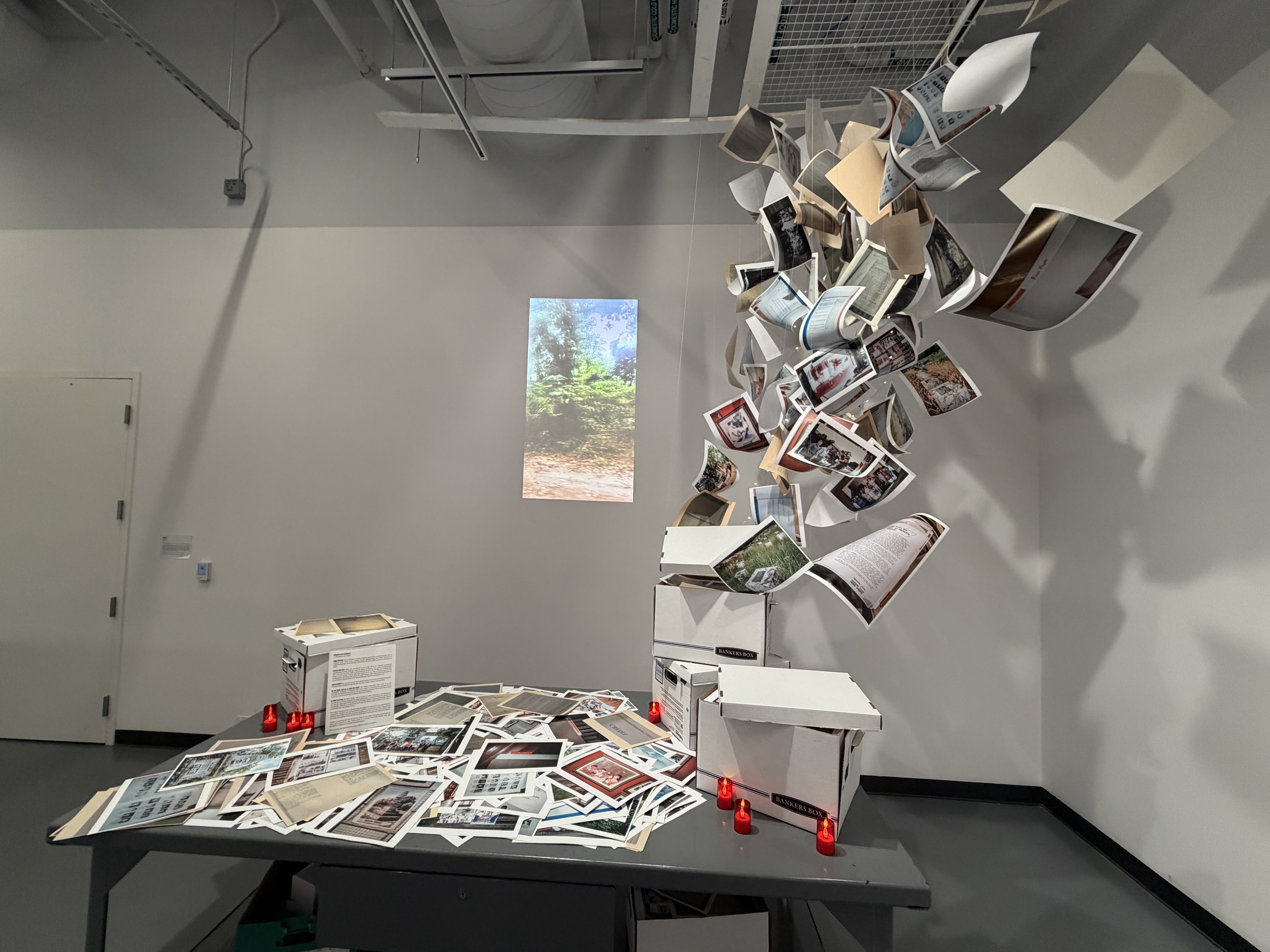
The camp is the archive room's story, and it comes closest to matching the tapes. In January 2025 French talked her way into the Philippine Refugee Processing Center in Bataan, where her own family waited in 1990, and carried out photographs and documents now spilling from actual Bankers Boxes, some suspended midair in a cyclone of pages, the rest loose on a table where you may handle them. Her wall text says these stories don't belong in banker boxes secured by guards. The camp itself, she notes, is being rebuilt as a US military training complex. You could not invent a bitterer ending. But the room keeps undercutting its material. Photographs on printer paper, curling. Her mother's words, including the recent discovery of Amerasian origins, on slim wrinkled strips at dorm-corkboard height. On one strip, the artist asks her grandmother whether she ever loved the American soldier. The answer, two letters long, outguns every canvas in the building, and it is taped to the wall like a reminder to buy milk. Battery votives flicker nearby. I know the defenses: the refugee archive is itself creased paper, a vitrine would embalm what she wants touched, electric candles are what real altars use. All true, and beside the point. Boltanski built memorials from biscuit tins and clip lamps, and every shadow was rehearsed. Undecided placement is what a message looks like before form has metabolized it. And she can decide when she chooses: across the room, heirloom áo dài stand with a vintage sewing machine and a new áo dài she airbrushed with her own flames, Doc Martens painted to match, three generations of one garment arranged with intent. The hand is never in doubt either. A horse made of fire, white chrysanthemums slashed out of black: aerosol control of a high order, velvet gradients and knife-edge strokes from the same can, the touch four hundred walls will teach you. Skill like that deserves its sentence. It just isn't the question a gallery asks.
Some of this is the venue, honestly admitted: a teaching gallery, a debut, students in the install, a whole career's worth of material fighting for one room. The fall of Saigon turned fifty last year, and that history deserves a major exhibition, of which this is a moving rehearsal. The tears in the room were real, and they belonged to the history. The art happened once, and it was made of tape.