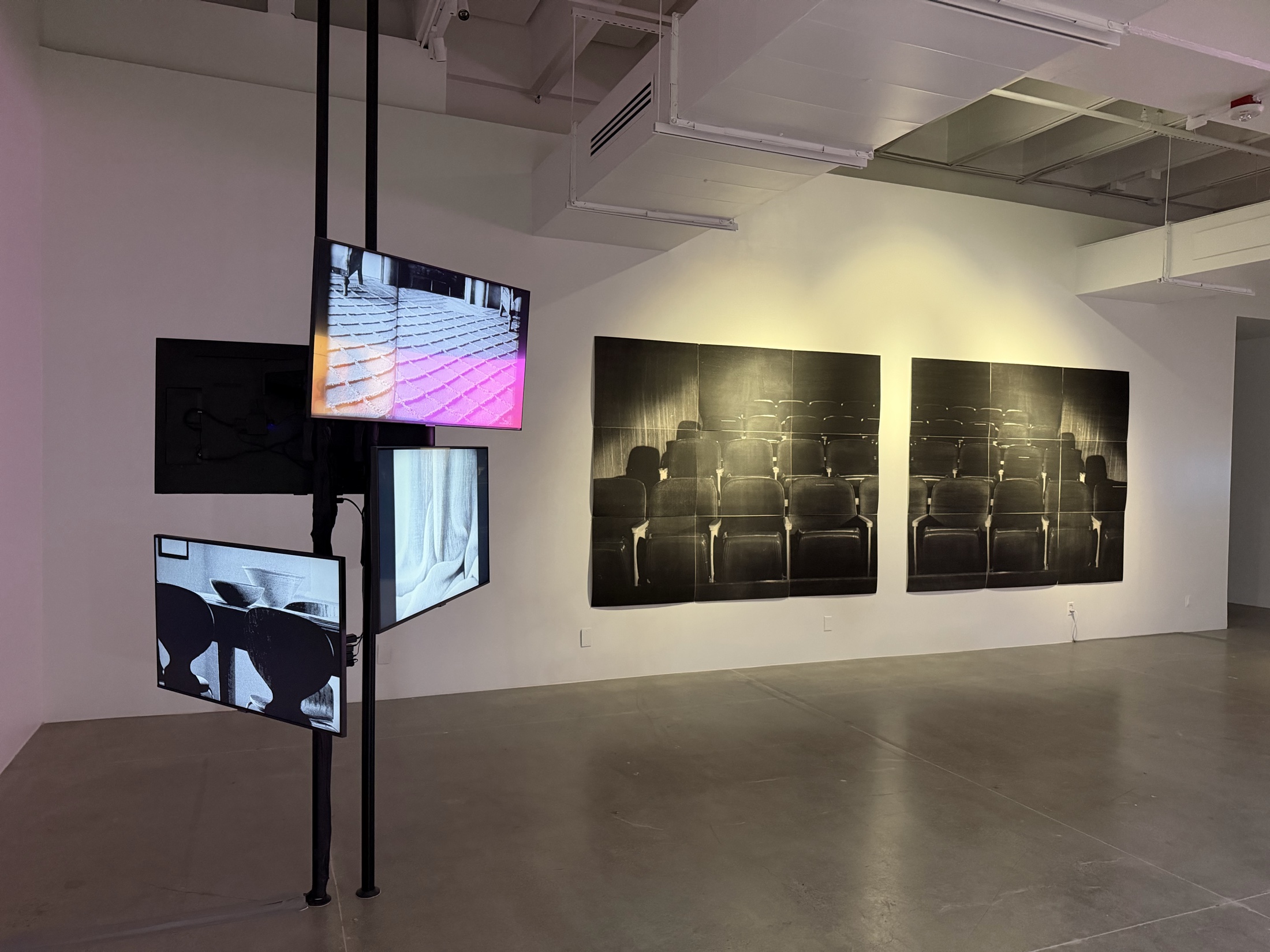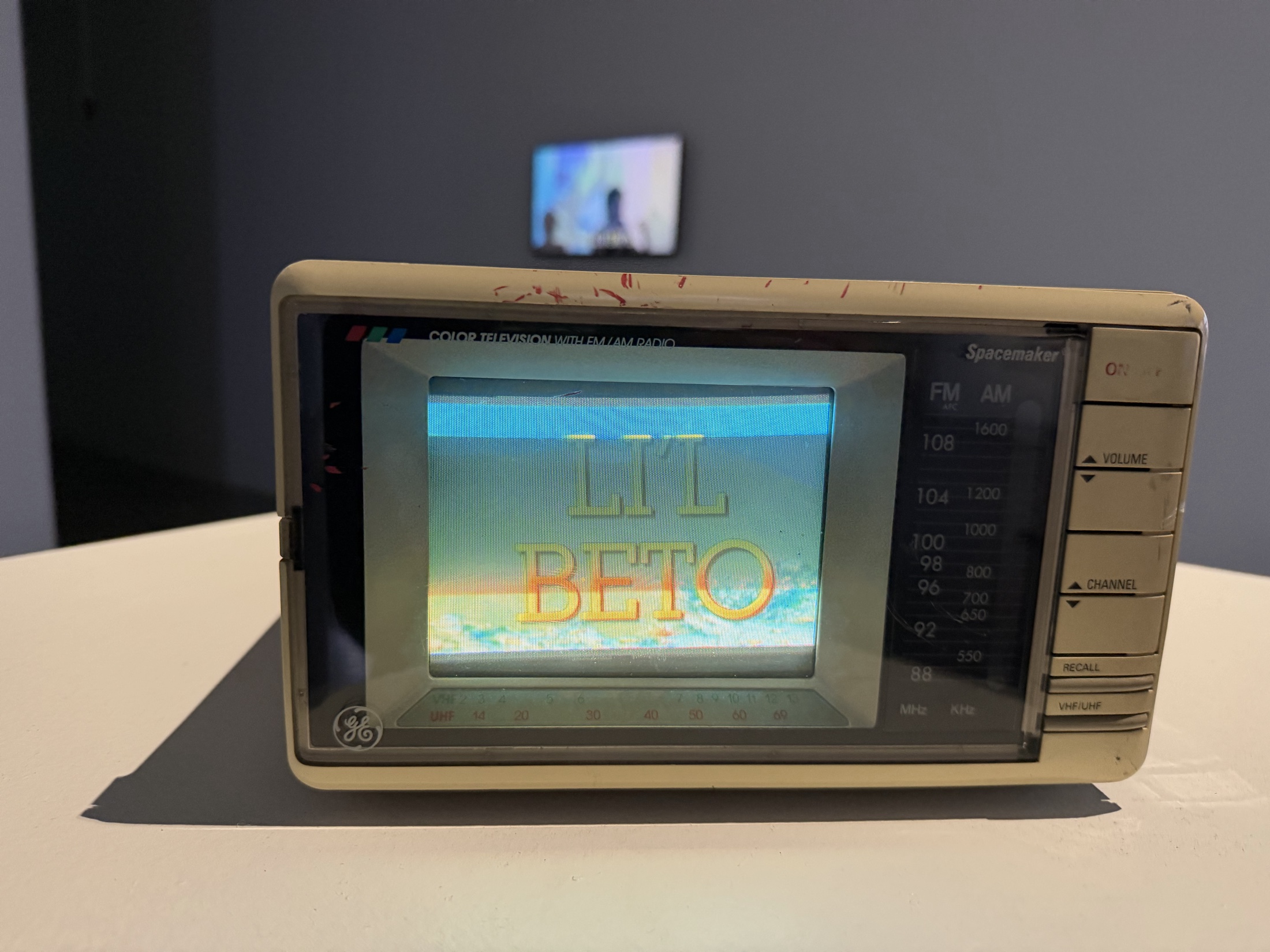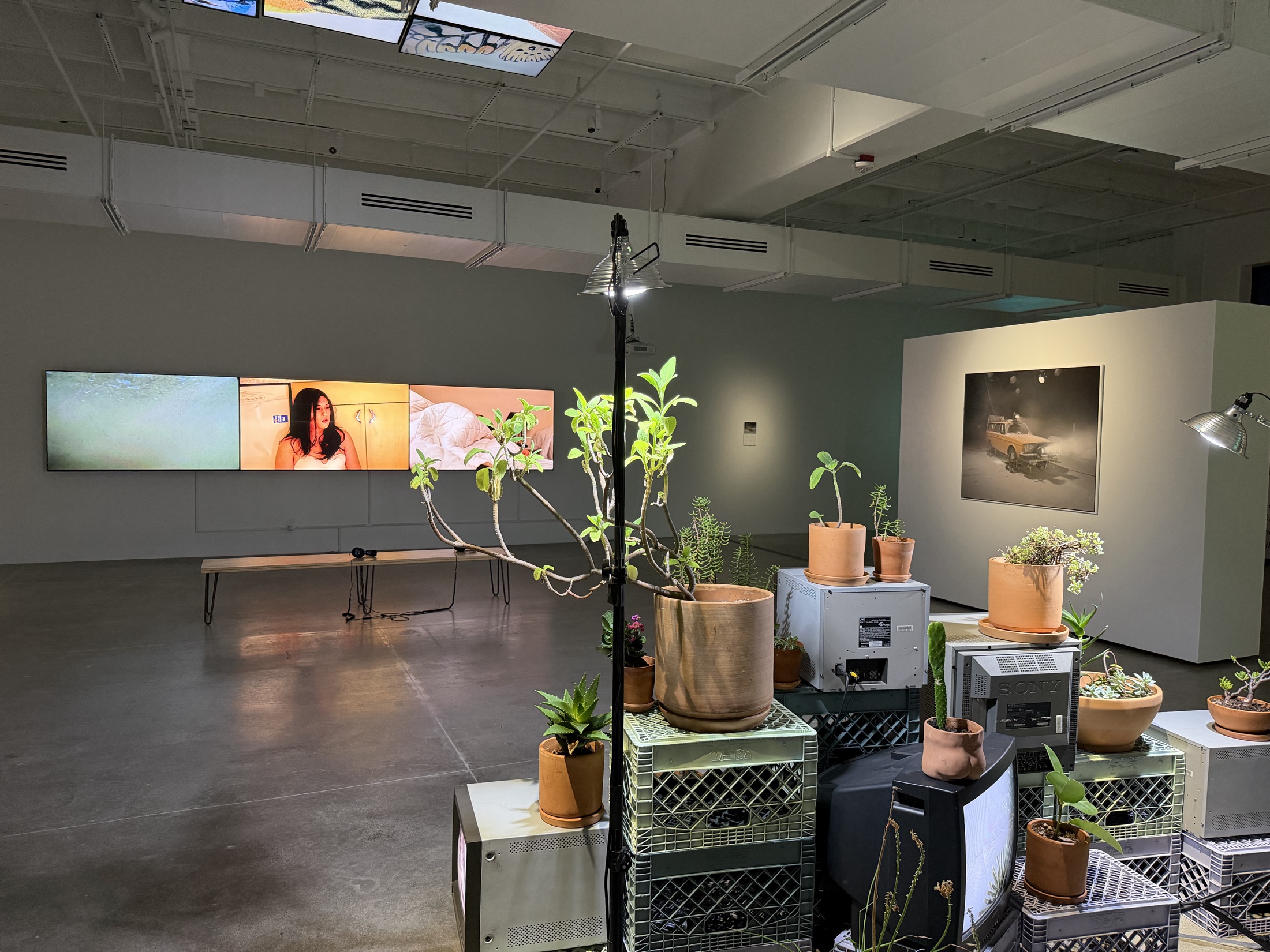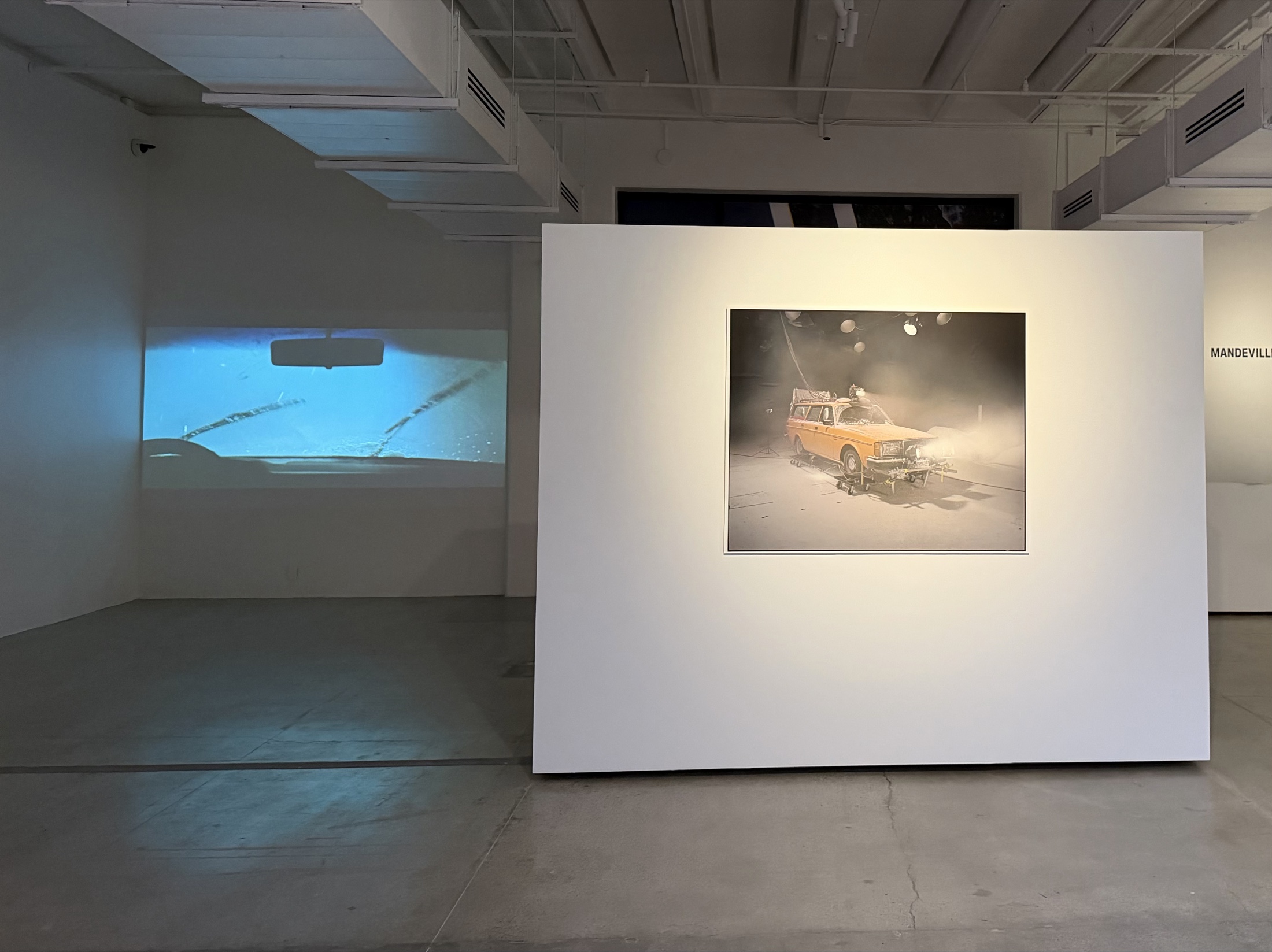
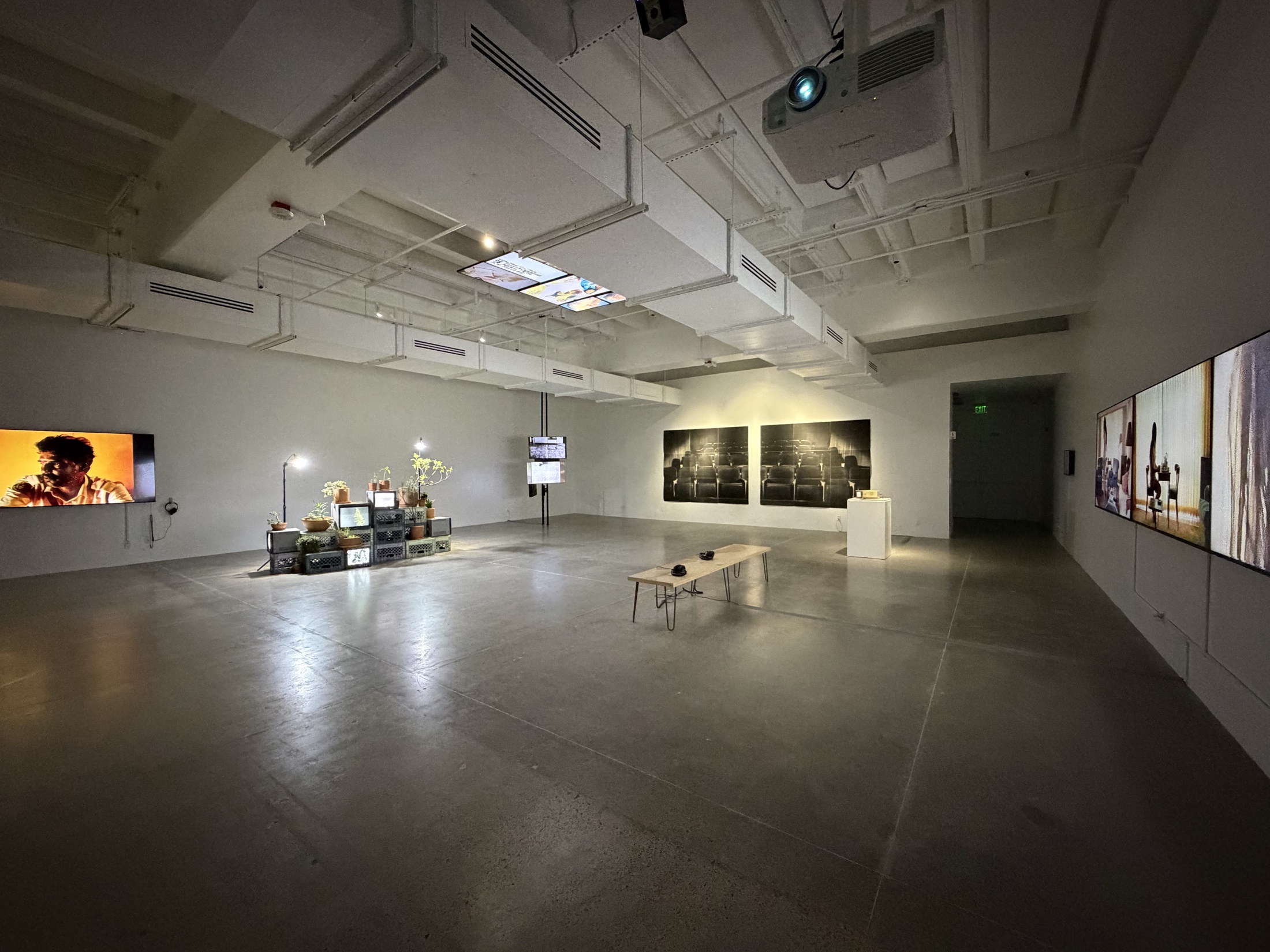
Installation view of Off-Screen Space at Mandeville Art Gallery. Photo: Sisif J. Patrick.
Where the Blondes Live
Off-Screen Space, Mandeville Art Gallery, through December 4
At UCSD's Mandeville Art Gallery, Alison O'Daniel builds "Off-Screen Space" with real sightlines, real wit, and a seventy-six-second masterpiece on a kitchen television.
SAN DIEGO, CA - Two weeks ago, in a university gallery across town, I wrote that the expanded field had lost its diagram. At the Mandeville Art Gallery, somebody drew one. Off-Screen Space, curated by Alison O'Daniel with the new Suraj Israni Center for Cinematic Arts, is the first show this season I can recommend without a limp. Sixteen works about the zone past the edge of the frame, hung by a curator who gets that a gallery has its own off-screen — what sits across from what, what waits around the partition — and that this is where an exhibition's meaning actually gets made. O'Daniel is the d/Deaf filmmaker behind The Tuba Thieves, and her whole practice has been about finding cinema in the places it touches the body. Here she's curated that knowledge into a floor plan. It helps that the building cooperates. Ceci Moss's rebuilt Mandeville stays open until eight at night, so a show about cinema's conditions can be seen in something like cinema's hours, and the LED facade outside — Victoria Fu's Colorways, two hundred three trademarked color names scrolling in spectral order — runs all night for a campus that mostly doesn't know it's an audience. I still owe that one a sidewalk visit after midnight. It keeps different hours than its own exhibition, which might be the point.
Inside, the diagram shows itself quietly. Dana Berman Duff's Catalogue films, knockoff furniture shot straight from the pages that sell it, play on monitors angled off black poles — a showroom taken apart and forced vertical. They face Lorna Simpson's Theater Seats from 1998: two big serigraphs of empty cinema seats, printed across eighteen panels of felt, the same material theaters use to swallow sound. Sofas for sale looking at seats for watching, both missing their bodies. I stood in that crossfire a while. Simpson's presence here has its own wiring — she took her MFA at UC San Diego in 1985, in the department this city keeps forgetting it should brag about, and the felt panels come from the collection of Michael Krichman and Carmen Cuenca, the people who ran inSITE. The gallery spent last spring honoring Faith Ringgold, who taught on this campus for eighteen years. Now it hangs the student generation. Universities don't usually remember themselves this well, and when one does, it's worth saying so in print.
And then there's Li'l Beto, which steals the show so thoroughly the show should press charges. Omar Lopex — San Diego/Tijuana, shoots celluloid only, and his checklist entry lists no medium at all, just the means: Kodak Vision3 50D, expired EXR 320T, an Arriflex, a Bolex, three old lenses, and one GE Spacemaker television. The film runs seventy-six seconds on the humblest screen in the building. A chubby kid cranks a manual power bank. The crank feeds a little kitchen TV. He loads a tape, and when a beautiful blonde actress fills the frame he kisses the screen, then looks into the distance and announces, in Spanish, that he's moving to America. His grandmother asks why from somewhere off-screen, where home always is. Because that's where the blondes live. Then he runs for the horizon in a T-shirt a size too small for him — a boy already outgrowing what home dressed him in — and the film ends, and loops, and he's back at the crank. I watched it more times than I'll admit to. Every reading pays off. Desire literally powers the cinema here; the image costs muscle, the way it did when all cameras were cranked, the way the spring-wound Bolex that shot him still does. The kiss lands on glass, which is where every kiss aimed at a screen has ever landed. The migration story this county usually tells in walls and night crossings gets retold at kid logic — the screen is the coyote. And the paint-flecked television on the pedestal is the same television from the film. The prop got promoted to reliquary, so the boy's lips meet the exact surface our eyes are pressed against. Cinema Paradiso needed two hours and let its boy grow up and leave. Lopex gives Beto seventy-six seconds and no arrival, ever. It is the best single work I have reviewed this season, and it plays on a secondhand kitchen TV.
The show's portrait of its own title hangs nearby. Christopher Richmond and Young Joon Kwak's Slow Dance stretches one figure across three screens — corseted, watched from every angle, a little sexual, a little bored, holding no device, performing toward nothing. I stood there asking the questions the piece wants asked. Waiting for what? Protagonist of what? Then the real one surfaced: is this what we are without a screen? A person as pure off-screen space, idling for a cue that isn't coming. Kerry Tribe runs the exhibition's spine from the front door. Her Near Miss greets you apparatus-first — the yellow wagon rigged with lights on its dolly, fog machines standing by — and only around the partition do you get the illusion: windshield, night, snow, the car starting to slide. Beside it hangs a pinned sheet, the same image shrunk above a handwritten first-person account of the crash, which ends by confessing the writer only heard the story in a California classroom in 2009, and that it "keeps being re-told in 1st person by crew members, friends, artists, and curators. It is not snowing here." A memory with more drivers than the car ever had. I watched the loop and waited for the accident. It doesn't come. The title warned me.
Not everything held me, and a review that loves everything is a press release. Sarah Rara's silent sunset sat too still to argue with me. Rajee Samarasinghe's film lost me at its turn — an animal, a dead fish, human menace, then a reach toward political address the images hadn't earned; it left me cold, and the film and I will both survive that. Kalman and Horn's Director's Karaoke — microphone, PA, bench, a pot of water for the director's thirst — is built to be performed, and no dates were posted when I checked, so what a visitor meets is karaoke with nobody singing. That might accidentally be the truest object in a show about off-screen space. It might just be incomplete. The gallery should schedule the singing and settle the question. Josh Tonies' Aberrant Phytology — live succulents among CRTs playing animated plants, grow lamps nursing both — is genuinely charming, two obsolescing life forms splitting the same light, but Nam June Paik planted this garden in 1974, and charm is what's left after the shock composts. Cute, and I mean that both ways. Jennifer West's Mothra Light Sky Screen puts six screens of giant moths on the ceiling, which makes us the porch light — a lovely inversion undersized by its hardware. A sky patched from televisions is a skylight. Moths deserve the whole ceiling, or the metaphor stays caged. And the dark annex of four single-channel works had moments I haven't earned the right to review yet; that room billed me for a second visit, and I intend to pay.
The accident never comes inside. It follows you out past the facade, where the color names are still scrolling for nobody, and somewhere behind you Beto is back at the crank, kissing the glass, announcing America, running at the horizon in his too-small shirt, seventy-six seconds at a time. Some shows you leave. This one loops.